Stair Installation in Wylie, TX & DFW
Carpet-to-hardwood and carpet-to-LVP stair conversions, new treads and risers, stair nose matched to your floor, and new carpet on stairs. Priced per step at a free in-home estimate.
Short answer: At Home Flooring Solutions installs stair flooring across Wylie, Plano, Garland and the rest of DFW — carpet, LVP, laminate and hardwood treads, with the risers and stair nose to match. Stairs are priced per step, and we count and measure them at a free in-home estimate before you get a written quote.
A typical stair project looks like this: a two-story home in Collin or Dallas County with new hard flooring downstairs (or plans for it) and the original builder carpet still on the stairs. The stairs are the last carpeted path in the house and they look it. Converting them is very doable, but it is a different job from laying a floor, and the decisions are worth understanding before you choose a material.
What We Do on Stairs
- Carpet-to-hard-floor conversions — tear out carpet, pad, tack strip and staples, then cover each step in LVP, laminate or hardwood.
- New treads and risers — hardwood treads matched to your floor, with risers covered or painted.
- Stair nose — the trim piece on the front edge of each tread and at the top landing, matched to your LVP, laminate or hardwood.
- Carpet on stairs — new carpet and pad, waterfall or wrapped, usually alongside new carpet in the bedrooms upstairs. See carpet installation.
What Is Under Your Stair Carpet
This is the question that decides the job. In most homes built by production builders across DFW, stairs that were carpeted from day one have treads made from particleboard, OSB or knotty pine, with a rounded overhang on the front edge. They were built to hold carpet, not to be looked at. Pulling the carpet and staining what is there does not work.
So a conversion means covering or replacing every tread and riser. The old rounded overhang on each tread usually has to be dealt with so the new tread and stair nose sit tight; we look at how your stairs are built at the estimate and explain the approach. Older custom homes sometimes do have oak treads under the carpet that can be sanded and finished; when that is the case, our refinishing crew handles it instead. We lift a corner at the estimate so you are not guessing.
Your Options, Material by Material
Carpet
The softest and most forgiving surface on a stair, and usually the lowest cost per step. Installed either waterfall style (carpet drapes over the nose to the next tread) or wrapped tight under each nose, which takes more labor but looks tailored.
Luxury vinyl plank (LVP)
A common carpet-to-hard-floor conversion in DFW two-story homes. Planks are glued to each tread and riser and finished with a stair nose made for the same product, so the stairs match the floor upstairs and down.
Laminate
Possible with a matching laminate stair nose, but the nose edge takes the hardest wear on any staircase and laminate is slicker underfoot. For that reason LVP is usually the better choice on the stairs, even when laminate runs through the rest of the house.
Hardwood
Hardwood treads and stair nose matched to your floor, with risers painted or finished to match. The most expensive option per step, and the one that can be sanded and refinished later.
Tile on stairs: we generally steer people away from it in a home. Tile is hard on a fall, slick when wet, and a cracked tread is a real repair. Our stair flooring guide covers why in more detail.
Matching the floor: if new floors are going in at the same time, choose the stair nose with the floor, not after. Not every LVP or laminate line has a matching nose, and a stair nose that is a shade off is obvious on a staircase. When the stairs meet an existing hardwood floor, new hardwood treads can be finished to sit with it, but an exact match on aged wood is not always possible; we will give you an honest call at the free estimate.
What Affects the Price of a Staircase
- Number of steps
- The main driver. A typical straight flight in a DFW two-story runs about 13 to 15 steps.
- Open vs. closed stringer
- A closed stair has walls on both sides. An open side shows the end of every tread, so each one needs a finished return and has to work around the existing balusters — more time per step.
- Box vs. bullnose steps
- Square box steps are straightforward. A rounded bullnose starter step at the bottom has to be shaped or wrapped to the curve.
- Landings and turns
- A landing is priced like a small floor. Pie-shaped winder steps in a turning stair need more cutting than straight ones.
- Tear-out
- Removing carpet, pad, tack strip and the hundreds of staples underneath, and preparing the old tread edge so the new tread and nose sit right.
- Risers
- Covering risers in the same material costs more than painting them. Painted white risers are a common, cheaper look with wood or LVP treads.
Stairs are quoted per step, and the plank or carpet is priced with the rest of the floor. Our LVP cost guide breaks out stair labor as its own line if you want a sense of how it is itemized. For your staircase, we count the steps, note the open sides and the starter step, and put it in a written quote at the free in-home estimate. Special financing on approved credit is available.
Stair Safety: What to Get Right
- Even step heights. Covering the treads adds thickness. The middle steps all rise together, but the top and bottom steps can end up taller or shorter than the rest if nobody plans for it. Residential codes generally allow no more than 3/8 inch of difference between risers in a flight, and an odd first or last step is where people trip.
- A real stair nose. The nose is what your foot finds on the way down. It has to be fastened solidly and finished so the edge is visible, not a plank simply wrapped over the front.
- Grip. Choose a matte or textured surface for hard-floor stairs. A runner down the middle is the usual answer for homes with small kids, older parents or dogs. Our aging-in-place flooring guide goes further on this.
- Glue, not float. Floating floors are fine on a level room. On a stair, every piece is glued and fastened so nothing shifts under a foot.
How a Stair Job Fits With the Rest of the Floor
Stairs are often done in the same visit as new LVP, hardwood or laminate on the first floor and the upstairs landing, so the house reads as one continuous floor. Doing them together means one stair nose decision, one set of transitions at the top and bottom, and one crew responsible for how they meet.
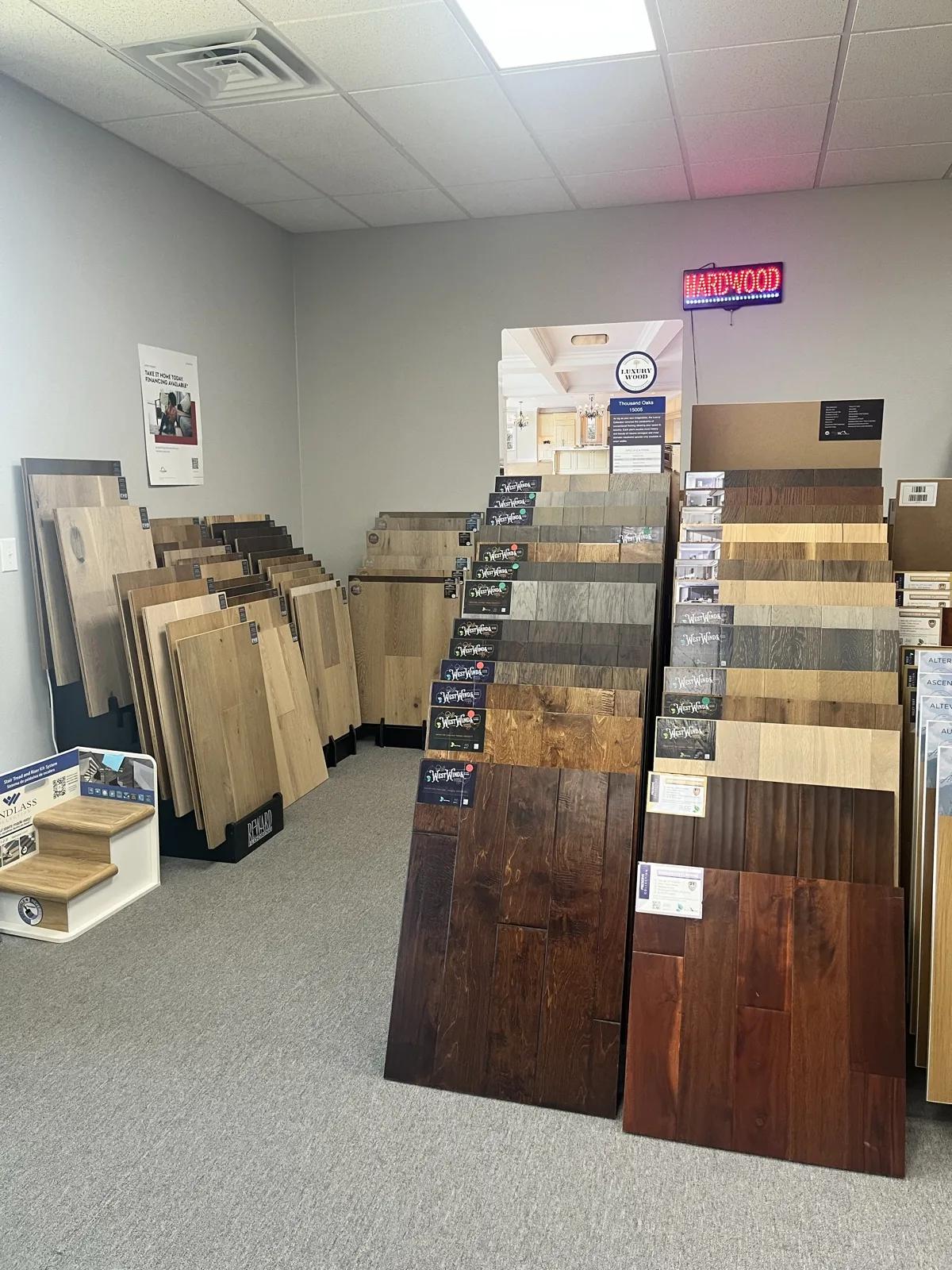
Furniture moving is free on our flooring installs, and you can see stair treads and full-size floor samples at our Wylie showroom at 1001 Alanis Dr Ste 120, Wylie, TX 75098.
Stair Installation Across These DFW Cities
Stair Installation FAQs
Can I pull the carpet off my stairs and just refinish the wood underneath?
Usually not in a DFW builder home. Stairs that were carpeted from the start are almost always built with construction-grade treads (often particleboard, OSB or knotty pine) that were never meant to be seen. Sanding them does not produce a finished stair. The fix is to cover or replace each tread and riser. We lift a corner of the carpet at the free estimate so you know what you actually have before you pick a material.
How is stair installation priced?
Per step, not per square foot, because a stair is mostly cutting and fitting rather than area. The count of steps, whether one side is open, whether the bottom step is a rounded bullnose, any turns or landings, and how much carpet, pad and tack strip has to come off all move the number. We count and measure at the free in-home estimate and give you a written per-step quote.
Can luxury vinyl plank go on stairs?
Yes. On stairs, LVP is glued down rather than floated, each tread is finished with a stair nose made for that product, and the risers are covered in plank or painted. The one thing to check before you buy the floor: make sure a matching stair nose exists for that exact product line. Some planks have no matching nose, and a mismatched nose is the first thing anyone notices on a staircase.
Will new treads change the height of my steps?
Covering every tread adds the same thickness to each step, so the middle of the staircase stays even. The top and bottom steps are where it can go wrong, because the floors at the landing and at the bottom may not change by the same amount. Residential building codes generally limit the difference between riser heights in a flight to 3/8 inch, and an uneven first or last step is a trip hazard. That is why the material thickness at the top and bottom of the flight has to be planned before anything is cut. Ask any installer how they will handle it.
Are hardwood and LVP stairs slippery?
Smoother than carpet, yes. A matte or textured finish, a stair nose with a defined edge, and good lighting make the biggest difference. If you have small children, older family members or dogs that run the stairs, a runner down the center of hard-surface treads keeps the look and adds grip. Carpet remains the most forgiving option underfoot.
Get a Per-Step Quote for Your Stairs
We'll count the steps, check what is under the carpet, and leave you a written quote for carpet, LVP or hardwood — no pressure, no surprise add-ons.